

The decision was widely publicized and frequently misunderstood. It is important to distinguish what actually occurred from what remained unchanged.
On June 25, 2026, the Brazilian Federal Supreme Court suspended, for 90 days, the imposition of fines and other penalties based on the provisions of NR-1 addressing work-related psychosocial risk factors.
The Supreme Court suspended the imposition of penalties; it did not eliminate the duty to manage these risks. For companies, this distinction is critical.
Portaria MTE n.º 1.419/2024 expressly included work-related psychosocial risk factors within the scope of Occupational Risk Management (GRO). Employers are now required to identify, assess, control, and monitor not only physical, chemical, biological, ergonomic, and accident-related risks, but also organizational factors capable of impairing workers’ health.
The focus is on working conditions, not on the individual: the regulation does not require clinical diagnoses, psychological monitoring, or the collection of employees’ medical data. Work overload, harassment, recurring conflicts, lack of clarity regarding job responsibilities, and excessive working hours must now be assessed within the risk management framework.
GRO and PGR: The Risk Management Framework
Two concepts are often confused, and understanding them is essential to achieving effective compliance.
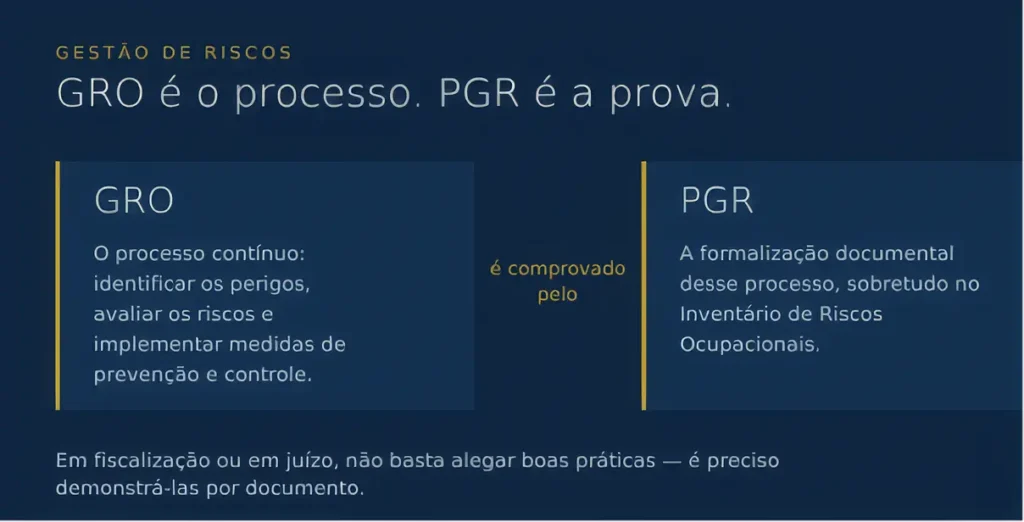
The distinction is legal, not bureaucratic. Under Portaria 1.419/2024, psychosocial factors became a mandatory part of this cycle.
What the STF Decided
In considering ADPF n.º 1.316, filed by the National Confederation of Educational Institutions (CONFENEN), Justice André Mendonça partially granted the request for interim relief, subject to ratification by the Plenary, suspending for 90 days the enforcement of penalties under five provisions of Chapter 1.5 of NR-1 (items 1.5.3.1.4, 1.5.3.2.1, 1.5.4.4.2.1, 1.5.4.4.2.2, and 1.5.4.4.5.3).
At the preliminary review stage, the decision is based on the understanding that NR-1 does not provide sufficiently objective criteria—regarding what constitutes psychosocial factors, which methodology should be adopted, and when measures will be deemed insufficient—to support the imposition of penalties without violating the principles of legality, definiteness, and legal certainty. The case was referred to the STF’s Center for Consensual Dispute Resolution (NUSOL) for conciliation between CONFENEN and the government.
Unlike previous decisions on the matter, this interim ruling has general applicability. Because it was issued in a centralized constitutional review proceeding, it applies to all companies with employees governed by Brazil’s Consolidation of Labor Laws (CLT), regardless of industry or state—unlike the decisions issued in prior industry-specific actions, such as those brought by FIESP and CNSaúde, which were limited to the respective plaintiff entities. It is also broader in scope: five provisions, compared with three under the preliminary injunction obtained by FIESP.
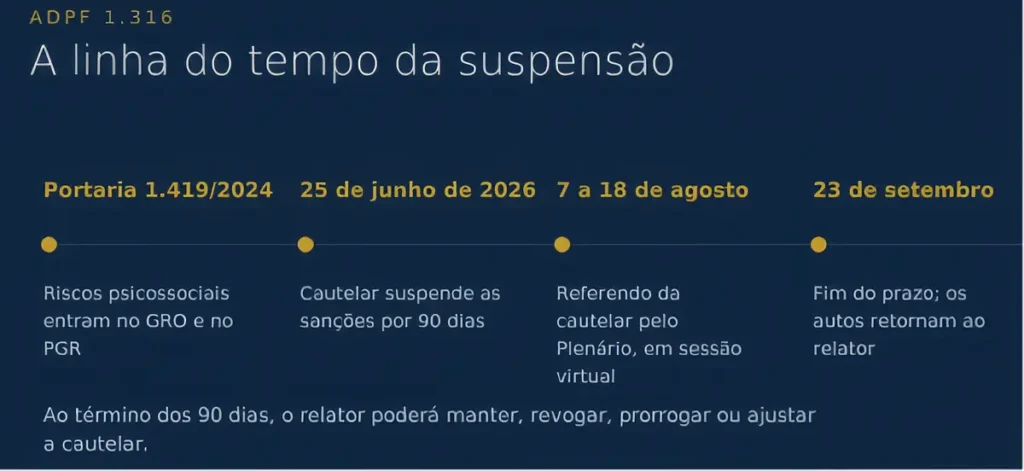
At the end of the 90-day period, the reporting Justice may maintain, vacate, extend, or modify the interim ruling.
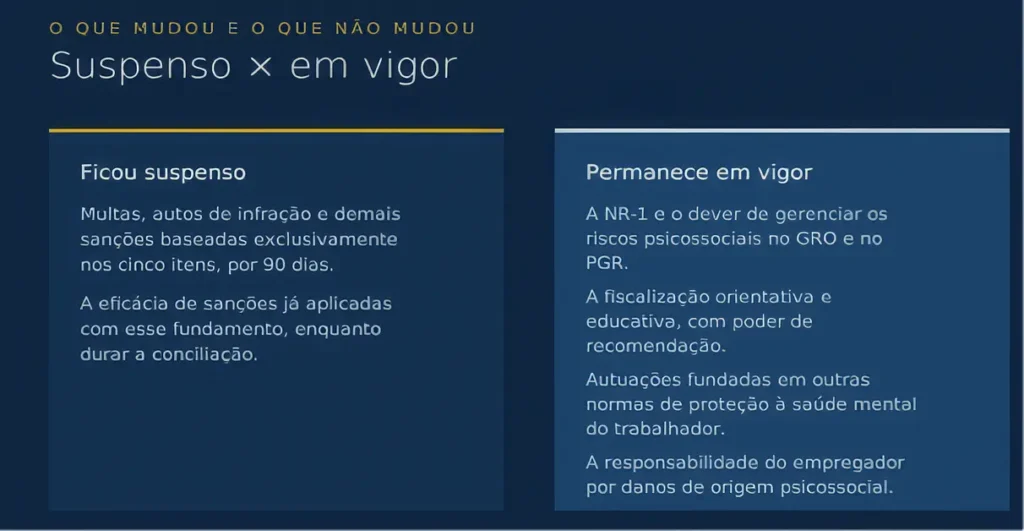
Why Prevention Efforts Must Continue
The suspension is temporary and limited in scope. Three reasons make it imprudent to treat it as a reprieve.
- The Labor Public Prosecutor’s Office is not bound by the Labor Inspectorate’s timetable: it may initiate civil investigations and enter into conduct adjustment agreements regardless of the penalty-enforcement phase.
- In judicial proceedings, the absence of preventive measures and supporting documentation weakens the defense in claims involving burnout, anxiety, depression, and other health conditions. It bears noting that art. 20 da Lei n.º 8.213/91 treats an occupational disease as equivalent to an occupational accident and that § 2º exceptionally recognizes an unlisted disease when it results from the special conditions under which the work is performed.
- The Risk Inventory records must be retained for 20 years. In practical terms, this is the company’s exposure horizon: a poorly prepared PGR today may be used as evidence for many years to come.
What to Do Now
— Maintain – and do not dismantle – the psychosocial risk management measures already in place. Removing documentation weakens the company’s position.
— Complete the identification of psychosocial factors and incorporate them into the Risk Inventory, with an action plan, designated persons responsible, and deadlines.
— Use the 90-day window as a period for technical adjustments, not inaction.
— Monitor the Plenary’s ratification, the NUSOL proceedings, and the expiration of the suspension at the end of September 2026.
In Summary
NR-1 remains the subject of considerable controversy, and the outcome of the legal dispute is still uncertain. What the suspension of fines does not change, however, is the actual risk: unhealthy work environments continue to result in employee leaves of absence, turnover, and litigation exposure—with or without administrative enforcement action.
Prevention does not depend on the outcome of the case; the cost of work-related illness, however, is already real and measurable today. It is for this practical reason, more than any degree of regulatory certainty, that psychosocial risk management must remain at the center of the corporate agenda.