
The Tension Between the Effectiveness of Labor Claims and the Logic of Universal Bankruptcy Jurisdiction

In a recent decision rendered in Complaint No. 84,513/SP, the Brazilian Supreme Court emphatically reaffirmed the limits on Labor Court jurisdiction in the enforcement of labor claims against companies undergoing judicial recovery, particularly with regard to piercing the corporate veil.
On that occasion, the Court overturned a ruling by the Regional Labor Court of the 2nd Region that had ordered the continuation of enforcement proceedings directly against the partners of the company undergoing judicial recovery, recognizing a violation of the full bench reservation clause pursuant to Binding Precedent No. 10.
Far from representing an isolated understanding, the decision forms part of a well-established jurisprudential line within the Brazilian Supreme Court, guided by the preservation of the logic of bankruptcy proceedings and the centralization of enforcement actions in the universal bankruptcy jurisdiction.
In this regard, precedents such as ADI No. 3,934/DF and RE No. 583,955 (subject of general repercussion), both delivered by Justice Ricardo Lewandowski, had already established that, in cases of judicial recovery or bankruptcy, the universal bankruptcy court has jurisdiction not only over the enforcement of claims, but also over the analysis of measures that may impact the debtor’s assets and those of its partners, including piercing the corporate veil.
This understanding finds direct support in paragraph 2 of Article 6 and in Article 82-A of Law No. 11,101/2005, which limit Labor Court jurisdiction to the determination of claims, transferring enforcement to the judicial recovery court.

Delimitation of jurisdiction in judicial recovery: the Labor Court determines and liquidates the claim, while enforcement actions and the analysis of asset attachments are concentrated in the universal bankruptcy court.
At the same time, these provisions reinforce the need to observe the requirements of Article 50 of the Civil Code, enshrining the major theory of piercing the corporate veil, which requires a demonstration of abuse, characterized by deviation from purpose or commingling of assets.
The guidance adopted by the Brazilian Supreme Court, therefore, is not limited to the literal interpretation of the legislation, but is connected to the very structure of the bankruptcy regime, particularly to the principle of par conditio creditorum, which ensures equal treatment among creditors of the same class.
It is precisely from this point that the tension with established practice in the Labor Court arises.
Historically, the Labor Court has developed a practice guided by the principle of maximum effectiveness of labor claims, allowing, in certain cases, the continuation of enforcement proceedings directly against the partners of companies undergoing judicial recovery. This approach, in many cases, relies on a broad interpretation of piercing the corporate veil, inspired by the minor theory, as provided for in Article 28 of the Consumer Protection Code.
From this perspective, the very difficulty in fulfilling obligations — often evidenced by the state of judicial recovery — comes to be interpreted as a sufficient element to justify redirecting enforcement to the partners, regardless of the demonstration of abuse of corporate personality as required by Article 50 of the Civil Code.
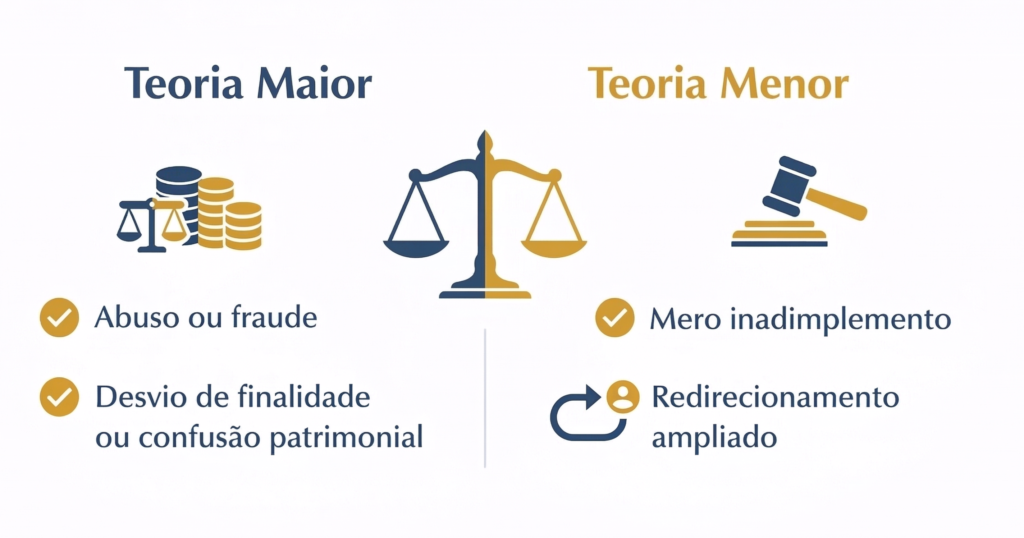
Criteria for piercing the corporate veil: while the major theory requires proof of abuse, deviation from purpose, or commingling of assets, the minor theory permits a broader interpretation based on default, which intensifies the tension with the bankruptcy regime.
Although this construction is linked to the protection of subsistence claims, its practical effects raise significant questions.
This is because, by allowing direct asset attachment against the partners, even in the face of the suspension of enforcement proceedings against the legal entity, an evident tension is created with the model established by Law No. 11,101/2005, which is structured precisely on the centralization of enforcement actions and the collective organization of claim satisfaction.
From the perspective of the restructuring regime, the suspension of enforcement proceedings does not constitute an isolated benefit to the debtor, but rather an essential mechanism to enable economic reorganization and the preservation of business activity. In this context, the possibility of parallel enforcement proceedings against the partners tends to undermine this balance, producing effects that transcend the individual relationship between creditor and debtor.
Moreover, the adoption of different criteria regarding the theory applicable to piercing the corporate veil — sometimes allowing the minor theory, sometimes requiring the major theory — contributes to heightened legal uncertainty, hindering the predictability of decisions and increasing litigation.
Another significant effect of this interpretative fragmentation is the potential impairment of equality among creditors.
The continuation of individual enforcement proceedings in the Labor Court, with the attachment of partners’ assets, may result in unequal treatment among creditors of the same nature, insofar as those who pursue swifter enforcement actions ultimately obtain an advantage to the detriment of those who submit to the collective regime of judicial recovery.
In light of this scenario of interpretative divergence, the controversy reached sufficient relevance to be submitted to the repetitive judgment procedure within the Labor Court.
Of particular note in this context is the assignment of Themes No. 26 and 42 of the Superior Labor Court, which address the definition of central issues for the harmonization of the system, particularly the Labor Court’s jurisdiction to process and adjudicate the corporate veil piercing incident against companies undergoing judicial recovery, as well as the possibility of continuing enforcement directly against the partners, including after the amendments introduced by Law No. 14,112/2020, and the delimitation of the applicable theory in cases where the company is undergoing judicial recovery.
The submission of the matter to the system of binding precedents demonstrates that the issue is still undergoing consolidation within the Superior Labor Court, particularly in light of the need for harmonization between the provisions of Law No. 11,101/2005 — especially Articles 6, paragraph 2, 6-C, and 82-A — and the guidance established by the Brazilian Supreme Court regarding the centralization of enforcement actions in the universal bankruptcy court.
The future definition of a thesis by the Superior Labor Court thus assumes a decisive role in stabilizing the controversy, insofar as it may more precisely delimit the scope of Labor Court jurisdiction in judicial recovery scenarios and establish clearer parameters for the application of the corporate veil piercing incident.
In this context, the guidance established by the Brazilian Supreme Court presents itself as the one that best aligns with the normative structure of Law No. 11,101/2005, by favoring the centralization of enforcement actions in the universal bankruptcy court and by requiring compliance with the requirements of the major theory of piercing the corporate veil.
More than a debate over jurisdiction, the issue involves defining the limits of judicial action in insolvency scenarios, particularly when seeking to reconcile the protection of labor claims with the preservation of bankruptcy logic.
The resolution of this controversy, therefore, does not depend solely on the reaffirmation of jurisdiction, but on the construction of a coherent decision-making standard among the courts, capable of reconciling the effectiveness of labor claims with the integrity of the bankruptcy regime.
The consolidation of clearer and more uniform criteria thus proves indispensable to ensure not only the effectiveness of judicial decisions, but also the stability and coherence of the legal system as a whole.