
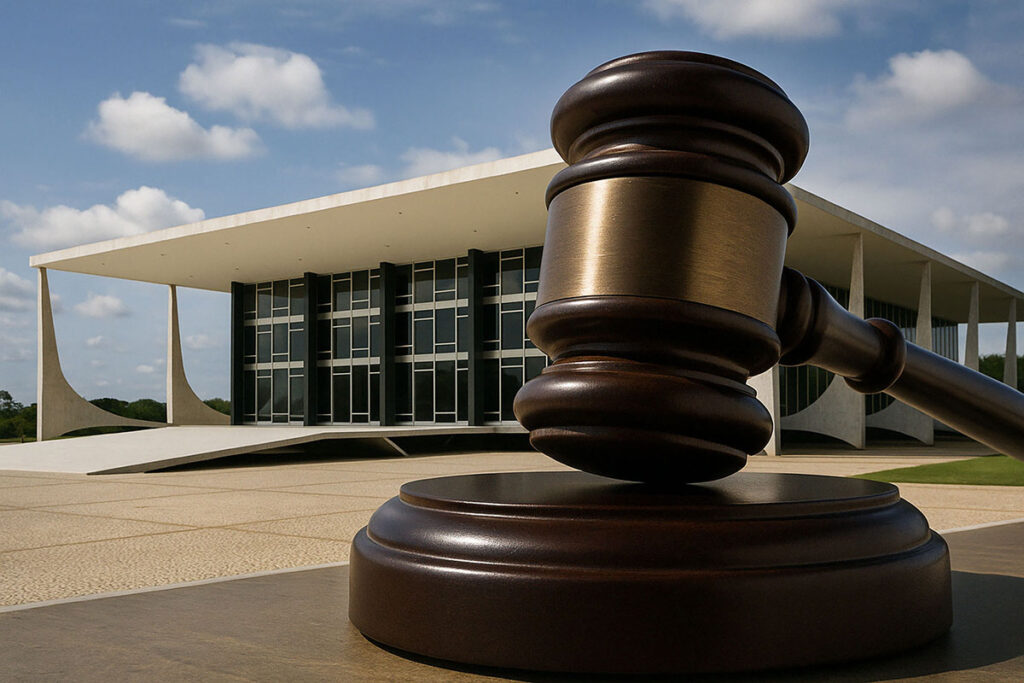
The Federal Supreme Court (STF) has decided to suspend, nationwide, lawsuits that discuss the legality of service contracts, known as “pejotização”. The decision, made by Justice Gilmar Mendes, aims to standardize the understanding of the issue and ensure legal certainty.
The STF recognized the general repercussion of the matter when it analyzed Extraordinary Appeal with Interlocutory Appeal (ARE) 1532603, which deals with jurisdiction and the burden of proof in cases that discuss the existence of fraud in civil/commercial contracts for the provision of services and the lawfulness of hiring a legal entity or self-employed worker for this purpose.
Although the appeal discusses “pejotização” in franchise contracts, the Reporting Justice clarified that the discussion is not limited to this type of contract, due to the increase in the volume of cases on the subject before the STF.
Justice Gilmar Mendes pointed out that many Constitutional Claims had been filed against Labour Court decisions that restricted the freedom of productive organization, despite the STF’s understanding in the ADPF 324 ruling, generating great legal uncertainty.
The nationwide suspension is not an automatic consequence of the recognition of the general repercussion, but is a decision of the rapporteur of the extraordinary appeal. Justice Gilmar Mendes, for this purpose, considered the competence of the Labor Court to judge cases that discuss fraud in civil contracts for the provision of services; the legality of hiring self-employed workers or legal entities to provide services; and the burden of proof in relation to the allegation of fraud in civil contracting.
With the suspension, the STF seeks to avoid the multiplication of divergent decisions on the subject, favoring legal certainty and fulfilling its constitutional role in pacifying social conflicts.